
I Compared Five Fingertip Pulse Oximeters for a Month – and the One I Kept Was the Cheapest on the Table
Our review team lined up the German wrist monitor, the app-connected models and a sleep-lab flagship against a device most people have never heard of. I fully expected the famous brands to walk it. Here’s what actually happened.
The phone call that started this review came on a Sunday evening. My mother – seventy-eight, lives alone, fiercely independent – mentioned, almost in passing, that she’d felt light-headed at the top of the stairs that morning. “But I’m fine now,” she said. And that was it. That was the entire report I had to work with: a feeling, described second-hand, from an hour’s drive away.
Maybe you know that helplessness from your own life. Slower on the morning walk than you used to be. A little winded carrying the groceries in. Back from a run or a long flight and feeling vaguely “off”. It could be nothing. It could be worth a call to the doctor. Without a number, you’re stuck interpreting a feeling – yours, or someone else’s.
Here’s the thing: there has been a tool for this for years. It’s the little clip a nurse puts on your finger at the start of nearly every appointment, before anyone even asks why you’ve come. In seconds it reads two numbers – your blood oxygen saturation and your pulse rate. A fingertip pulse oximeter does exactly that same check, except it lives in your kitchen drawer instead of a clinic.
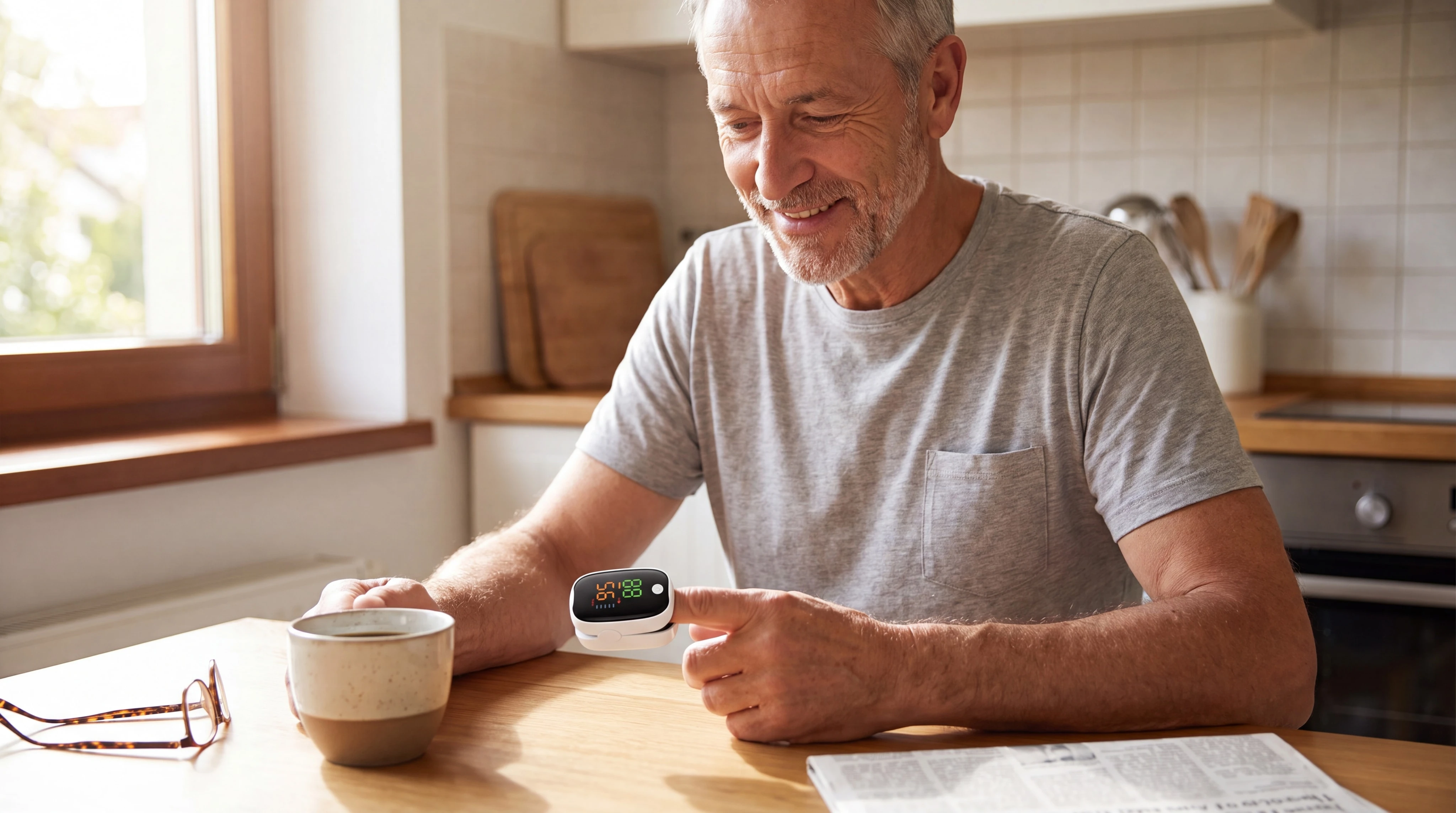
The catch is that the category is crowded, and much of it is built wrong for the people who actually buy it. Some devices tether every reading to a phone app you’ll open twice and then forget. Some charge sleep-lab money for features you’ll never have a use for. So our team did what we always do: we bought the leading picks and lived with them. VitalOxy, the PULOX PO-400 Wrist Pulse Oximeter, the ViATOM Wrist Sleep Oximeter, the ChoiceMMed MD300C29 and the iHealth Air – weighed on reading speed, accuracy specs, screen readability, setup friction, guarantees and price.
Going in, I assumed the biggest brand name would win. It didn’t.
The Device I Nearly Didn’t Order
The winner was the one I added to the test basket almost as an afterthought. VitalOxy is a compact fingertip pulse oximeter sold directly through its own official checkout, and it costs less than every rival we compared. That price was precisely why I was sceptical – cheap health gadgets are usually cheap for a reason. But it came with a written 30-day money-back guarantee, which made trying it a risk I could live with.
Using it is almost insultingly simple. Clip it onto a fingertip, press the single button, and in about five seconds your blood oxygen level and pulse rate appear on the display. Take a reading at the same time each day and you quickly learn what’s normal for you – which is what makes the odd days stand out. After a month of daily use, these are the things that put it at the top of our list:
A reading in about five seconds
No warm-up, no pairing, no waiting for a phone to cooperate. After the stairs, after a run, after that “I feel a bit off” moment – you get the number before the worry has time to grow. Speed sounds like a small thing until someone in the house feels dizzy.
Numbers that agree with themselves
Stated precision is ±2% on blood oxygen and ±1 BPM on pulse – tight enough that back-to-back checks match instead of bouncing around. That consistency decides whether a device gets used at all. A monitor you trust becomes a habit; one that contradicts itself ends up at the back of a drawer.
A large HD LED display you can read at arm’s length
A lot of fingertip monitors have screens that are dim, small, or both – fine if you’re thirty with sharp eyes, less fine if you’re the person these devices are usually bought for. VitalOxy puts up big, bright digits. No hunting for glasses first.
The screen flips to face whoever’s looking
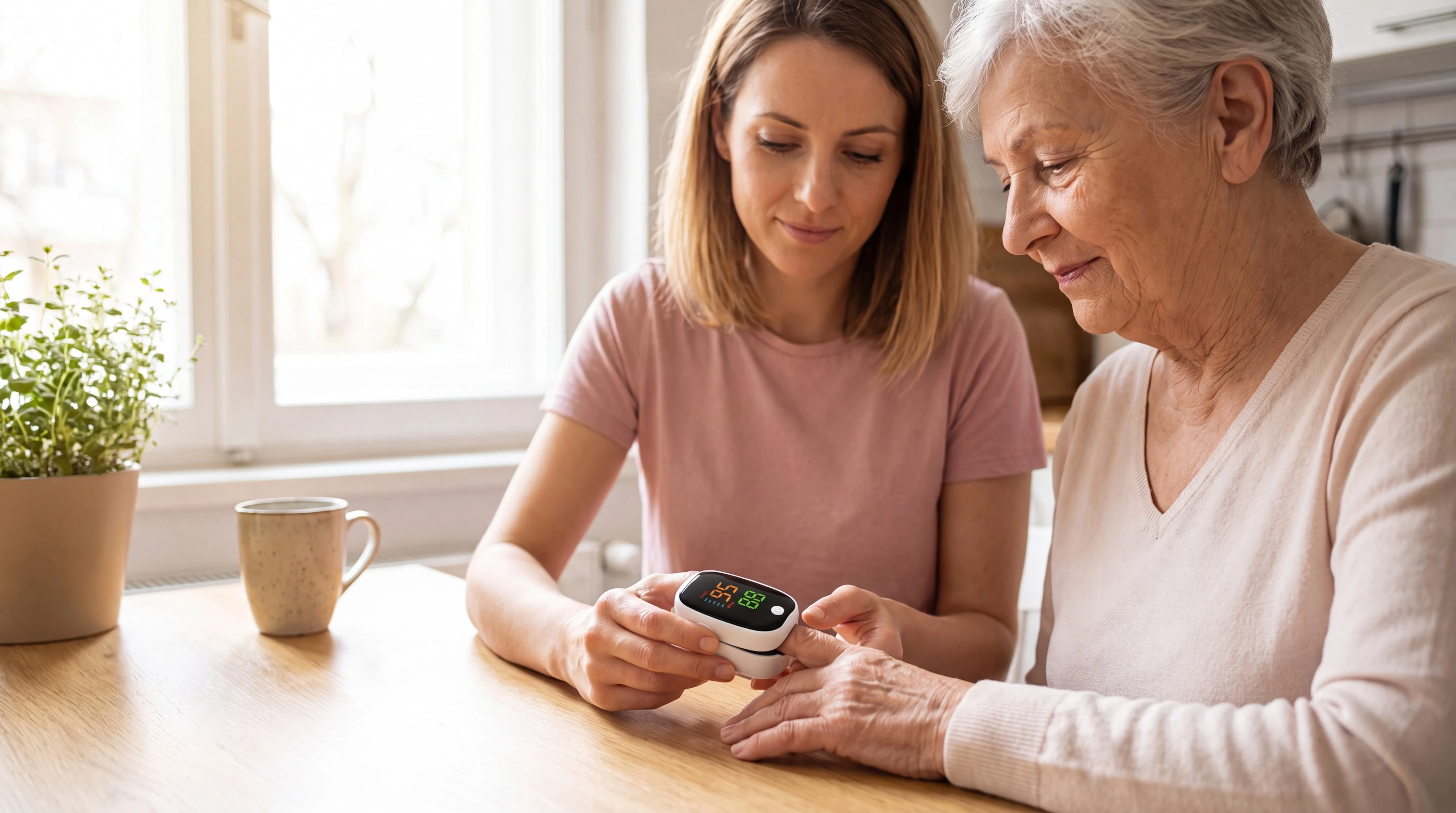
This is the detail I ended up liking most. The bidirectional display turns the reading toward whoever needs it. Check your own finger and the numbers face you. Check your mother’s finger across the table and they flip toward you instead of sitting upside down. Most standard monitors simply skip this.
One button. Truly one.
There is no app, no Bluetooth pairing, no account to create, no subscription hiding behind a free trial. Press, read, put it back. If you’re buying this for a parent who distrusts technology, that simplicity is worth more than any line on a spec sheet.
Small enough to forget it’s there
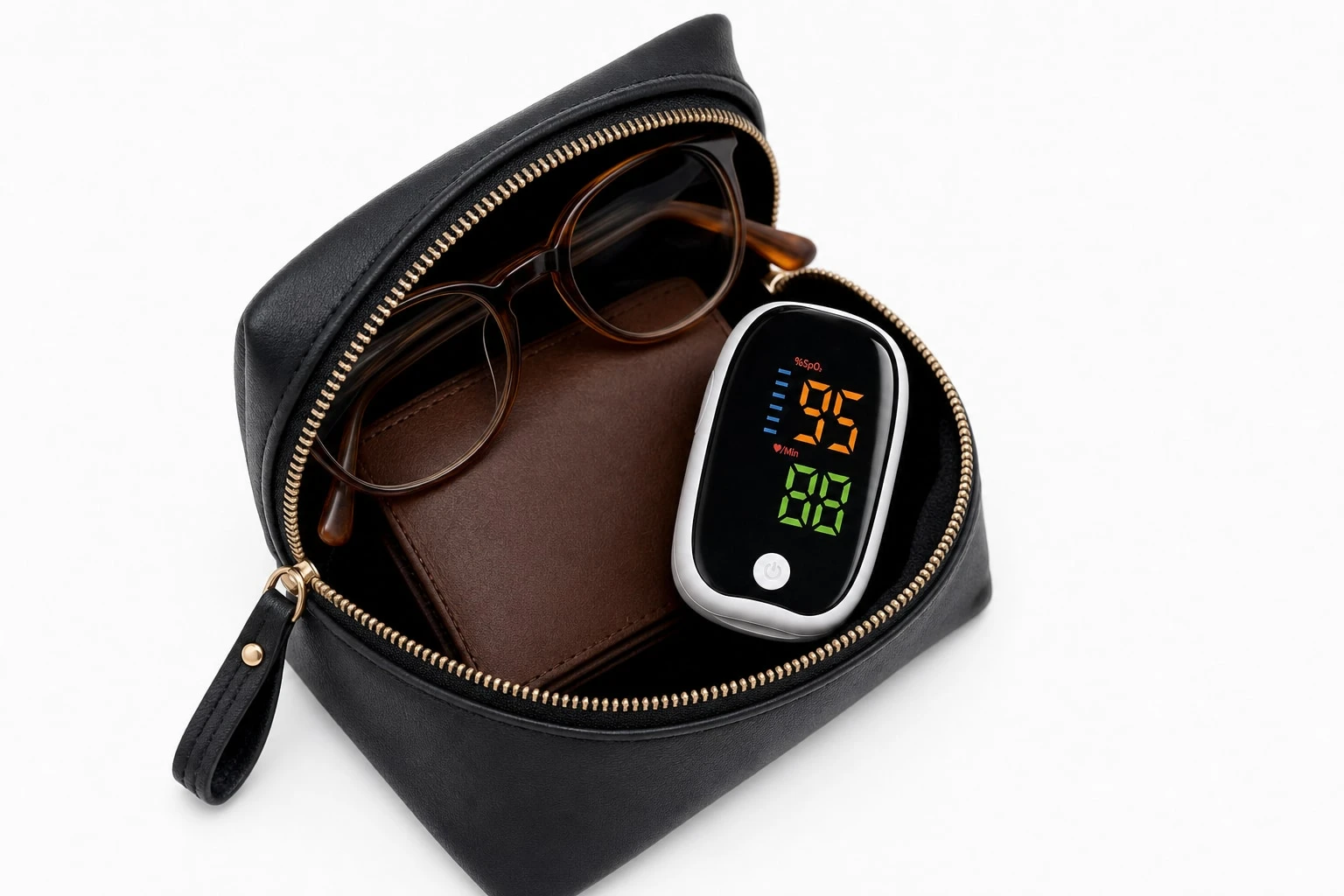
It’s compact and lightweight enough for a coat pocket, a handbag or a carry-on, and its low power consumption means it keeps working check after check without demanding attention. It travels as well as it sits in a drawer.
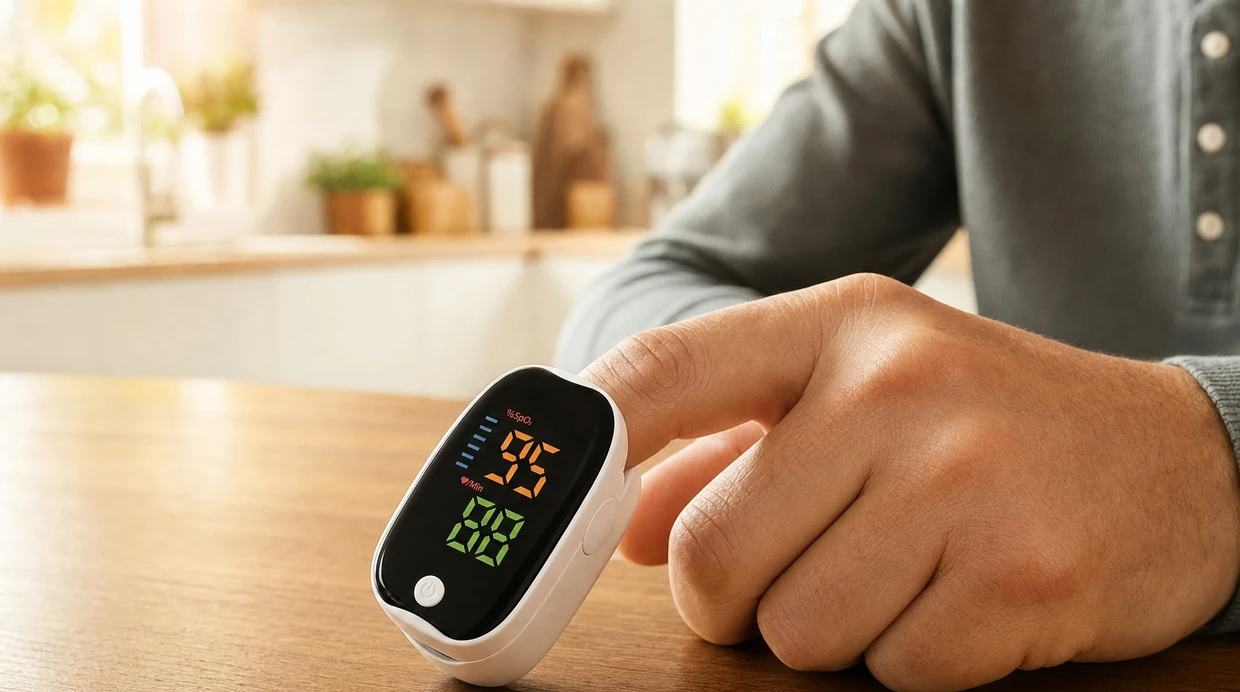
One honest caveat, because our team promised to write these reviews the way we’d talk to family: VitalOxy won’t graph your sleep overnight or sync a year of history to your phone. If your doctor has asked for continuous overnight data, buy hardware built for that job – that’s what the €189.99 ViATOM exists for. But if what you want is a fast, clear answer the moment you feel off, this is the better tool, and the one the whole household will actually use.
How the Famous Names Fell Away
The PULOX PO-400 Wrist Pulse Oximeter (€119.90) was the device I expected to win – German-engineered, clearly serious kit, and genuinely impressive at its actual job. That job, though, is overnight monitoring: it’s a wrist-worn recorder with a cabled fingertip sensor, built to log a whole night’s readings and export them to PC software. For the five-second spot check most households actually need, a wrist unit tethered to a finger cable is the opposite of convenient – and it costs well over twice VitalOxy’s price.
The ViATOM Wrist Sleep Oximeter (€189.99) is impressive kit for dedicated sleep tracking – and almost four times the price of our winner, with a wrist-worn rig that’s plainly bulky for a quick daytime check. It’s built for a job most buyers don’t have.
The ChoiceMMed MD300C29 (€64.48) does the fingertip job competently, but the maths is unkind: nearly 30% more than VitalOxy for essentially the same two readings, with no standout feature to justify the difference.
And the iHealth Air (€52.99), the cheapest of the competitors, still costs more than VitalOxy while routing readings through a phone app – extra friction for what should be a five-second check.
What Happened When I Handed It to My Mother
The real test wasn’t in my kitchen; it was in hers. I left the VitalOxy on her hall table with a one-line instruction: clip, press, read. She now checks after her morning walk, unprompted – and when I visit, the screen flips to face me across the table while it’s still on her finger. Our Sunday calls have numbers in them now, not just “I’m fine”.
I thought it would be another gadget I’d need you to set up. There was nothing to set up. I pressed the button and there it was.
★★★★★ my mother, three weeks in.
“I check after long runs now. It’s in the same pocket as my keys – I forget it’s there until I want it.” – a colleague on our review team who took the second test unit.
The wider numbers say the pattern isn’t just my household: the brand reports more than 25,000 satisfied customers and over 5,000 verified reviews.
The Questions I’ve Been Asked Since
How does it actually work?
Clip VitalOxy onto a fingertip, press the single button, and in about five seconds your blood oxygen level and pulse rate appear on the HD LED display. There’s nothing to configure and nothing to learn – which is exactly why it gets used.
Do I need a smartphone, an app or a subscription?
No. VitalOxy is fully standalone. Every reading shows directly on its built-in bidirectional display. No accounts, no pairing, no ongoing fees – which is also what makes it genuinely usable for older family members.
How long does delivery take?
Orders ship free and are dispatched within 24 hours on working days from an EU warehouse, with an order confirmation and a tracking number on every order – so delivery in Germany is quick, with no overseas transit legs and no surprise customs charges for EU buyers.
Why is it cheaper than the pharmacy brands?
Because it skips the shelf. VitalOxy sells directly online with no retail middlemen, so the €99.99 list price drops to €49.99 under the current launch pricing – and multi-packs bring it down as far as €33.33 per device. You’re skipping the markup, not the features.
What if it isn’t right for me?
Every order is covered by a 30-day money-back guarantee: if VitalOxy doesn’t suit you, contact customer service within 30 days of purchase for a full refund. That’s a month of real use in your own home to judge it – the only thing you commit up front is the time.
Can it replace a visit to my doctor?
No – and be wary of any gadget that implies otherwise. VitalOxy is a wellness monitoring tool that helps you stay informed about your oxygen levels and pulse rate. It doesn’t diagnose or treat anything. If a reading worries you, or you feel unwell, speak to a healthcare professional.
Now the Price – Because It Decided the Top Spot
Line the five devices up and the maths writes itself. The premium sleep flagship: €189.99. The German overnight monitor: €119.90. The mid-pack: €64.48 and €52.99. VitalOxy – five-second readings, ±2% stated accuracy, the HD LED bidirectional screen, one-button operation – currently costs €49.99 instead of the regular €99.99. That’s the 50% launch discount, applied automatically at the official checkout.
The multi-packs are where households win. A twin-pack comes to €69.99 – €34.99 per device – and the three-pack is €99.99, which works out to €33.33 each – the deepest of the multi-pack discounts the brand advertises at up to 73% off. That’s the sensible route if you want one at home, one at a parent’s house and one in the travel bag.
Every order ships free, dispatches within 24 hours on working days from an EU warehouse, and carries the 30-day money-back guarantee. Thousands of Germans have already made the same decision – and the guarantee means the risk of joining them is essentially zero.
One caveat I’d want a friend to hear: €49.99 is promotional launch pricing, not the standard price. The brand can withdraw the 50% discount at any time without notice, and once it ends the device returns to €99.99. Nobody outside the company knows how long it runs. If the discounted price is still showing when you open the offer page, it applies to your order – that’s the only guarantee anyone can give you about it.
My Verdict, Reviewer to Reader
The cheapest device on our list turned out to be the easiest one to live with – and that’s not a coincidence. Five-second readings mean it gets used. A big, bright screen that flips to face whoever’s looking means everyone in the house can use it. One button and no app means it never becomes a chore. And the full refund window means you don’t have to take my word for any of this.
It won’t diagnose anything, and it shouldn’t. What it ends is the guessing – for you, and for the people who worry about you from an hour’s drive away.
If any of this sounds like your household, do what I did: order VitalOxy from the official website while the 50% launch discount is still live, use it for a month, and let your own routine be the judge.